
Bishops · Church Fathers · Martyrs
Saint Polycarp of Smyrna
Polycarp, bishop of Smyrna, is known through his letter to Philippi and an early account of his martyrdom. These sources show his pastoral teaching and the memory of a community that gathered after his death.
- Feast day
- February 23
- Commemoration
- Catholic & Eastern Orthodox
- Region
- Asia Minor
- Lifetime
- First–second centuries
The life & witness
Who was Saint Polycarp of Smyrna?
Chapter 01 · Early texts and limits
A bishop in second-century Smyrna
Polycarp's birthplace, birth year, parents, and education are not securely described in the early texts used here. His own surviving letter names him alongside the presbyters of Smyrna, writing to the church at Philippi. A later Orthodox life adds an orphaned childhood and upbringing by a widow named Kallista, but those details are not in the Letter or the Martyrdom. The distinction matters: the early documents illuminate his mature ministry and death much more clearly than his early life. [1] [4]
Chapter 02 · Polycarp's Letter
Teaching another Christian community
In his Letter to the Philippians, Polycarp praises their faith, encourages truthful and generous conduct, and warns against greed. He addresses difficulties involving a presbyter named Valens and urges the community to seek repentance rather than treat those who stray as enemies. The letter also points to the suffering and Resurrection of Christ and draws extensively on apostolic teaching. It offers an unusually direct picture of Polycarp as a pastor concerned with the practical life and unity of Christians beyond Smyrna. [1]
Chapter 03 · Early martyrdom account
Arrest and confession
The church of Smyrna circulated a letter describing Polycarp's arrest, trial, and death. Its account places an elderly bishop before a Roman official who demands that he renounce Christ. Polycarp refuses. The letter is a near-contemporary Christian interpretation of his martyrdom, written to inspire other communities, not a detached court record. It describes the crowd, the official's threats, and Polycarp's prayer before execution. Its literary and devotional purpose should be recognized alongside its value as an early witness. [2]
Chapter 04 · Martyrdom narrative and legacy
Fire, death, and an anniversary gathering
The Martyrdom says fire surrounded Polycarp without consuming him at first and that an executioner then pierced him. These extraordinary details are claims of the early Christian letter, not independently testable events. The same text says Christians collected his remains and hoped to gather on the anniversary of his death. This is strong evidence for the community's early commemoration of a martyr without confusing honoring a witness with worship of Christ. Catholic and OCA calendars list Polycarp on February 23; later lives add details that should remain identified as tradition. [2] [3] [4]
Church calendars
How the churches remember Polycarp of Smyrna
These entries describe the named calendar sources below; they do not claim to survey every local church.
Catholic
In the Catholic Church
Catholic Church · Vatican News calendar
Commemorated February 23 · Date as listed in the Vatican News English calendar.
Calendar record [3]
Eastern Orthodox
In the Eastern Orthodox Church
Orthodox Church in America
Commemorated February 23 · Fixed date as listed by the OCA. Civil observance may differ in communities using the Julian calendar..
Calendar record [4]
Devotional memory
Miracles & traditions
These accounts belong to Christian tradition. Their details are not presented as independently established events.
Extraordinary account in the early Martyrdom
Fire around the martyr
The Smyrnaean letter says the flames arched around Polycarp and that he was finally pierced. The letter is early, but its miracle language should be presented as the community's testimony rather than an independently demonstrable physical event. [2]
Devotional reading
Prayer & devotion
Prayer for faithful witness with Saint Polycarp
Original composition · Shared Christian commemoration
Lord Jesus Christ, sustain your people when public pressure makes faithfulness costly. Through the prayers of Saint Polycarp, teach us to remember the witness of earlier Christians, to answer hostility without hatred, and to entrust our lives to you. Amen.
East & West Devotions · original devotional prayer
Research notes
Historical sources
References are linked to the chapters and calendar claims they support. A devotional account is distinguished from an independent historical record.
Artwork & rights
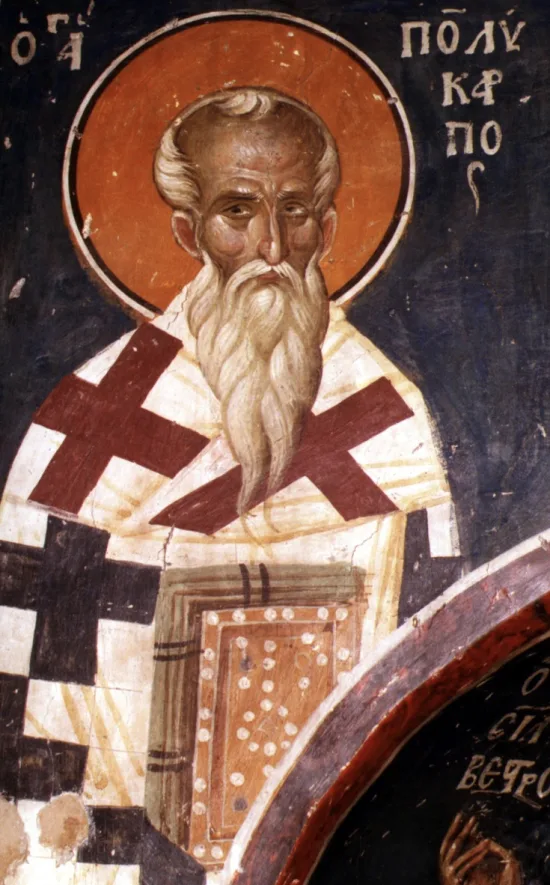
Polycarp of Smyrna2.jpg. Wikimedia Commons. Resized and converted to WebP. · CC0. View the source and rights record. This is a later artistic depiction, not a portrait from life.
Continue reading
Related saints & chapters

Published 2026-11-21 · Record reviewed 2026-11-21. Dates describe editorial review, not verification of every biographical claim.