
Shared foundations
Sacraments
At the font and the altar, Christians receive and celebrate life in Christ. Explore the sacraments and Holy Mysteries in East and West.
Read the guide ↓God’s gift in a visible action
In Romans, Paul connects being plunged into baptism with being buried and raised with Christ. The baptized person is to walk in a new way of life. In James, the sick person sends for the church’s elders, who pray and anoint with oil. Here the body, the prayer of others and God’s forgiveness all belong to the account of healing.
Catholic teaching identifies seven sacraments instituted by Christ and entrusted to the Church. In Orthodox usage these are often called mysteries. Orthodox Christians also commonly name seven, while Orthodox teachers caution against treating that number as a boundary around every way God sanctifies creation. Both traditions see water, oil, bread and wine as capable of bearing divine gifts in the Church’s prayer.
From the font to the table
Baptism, confirmation or chrismation, and the Eucharist belong together as initiation into Christ. In Byzantine Orthodox practice even an infant is baptized, anointed with holy chrism, and brought to Communion. The priest anoints with chrism consecrated by bishops. A local celebration thus expresses a bond with the wider Church.
Eastern Catholic churches also preserve the tradition of giving the three mysteries of initiation together. In the Latin Church adults ordinarily receive all three at initiation, while children baptized as infants usually receive first Communion and confirmation later. Where the bishop normally confirms, his presence makes visible a particular aspect of belonging to the apostolic Church. Different sequences express different pastoral and liturgical histories.
What the Eucharistic prayer asks
Paul recalls the supper on the night Jesus was handed over while confronting a community whose meals humiliated the poor. His account connects what is received at the table with responsibility for those who eat there. In the second century Justin describes the baptized assembly giving thanks over bread and a cup, and deacons bringing the gifts to those absent.
Catholics teach that the whole substance of bread and wine becomes Christ’s Body and Blood while their sensible appearances remain. The theological term is transubstantiation. Orthodox Christians likewise confess a real change. In the Byzantine prayer called the epiclesis the celebrant asks the Father to send the Holy Spirit upon the people and the gifts. Invoking the Spirit also belongs to Catholic eucharistic prayer. One tradition’s preferred vocabulary should not be used to decide whether the other takes Christ’s presence seriously.
Healing, marriage and ministry
Confession and anointing show how both churches pray for healing that concerns the whole person. In confession, a penitent acknowledges sin and receives the Church’s ministry of reconciliation. When the sick are anointed, the prayer asks for spiritual and bodily help. James describes elders gathering around the sick person. The practice belongs to the care of people during illness as well as at the end of life.
Holy orders sets apart bishops, priests and deacons for service. Marriage also has a public ecclesial form. In the Latin Catholic tradition the spouses confer the sacrament on one another through their consent. Eastern Catholic teaching requires the priest’s blessing for validity. In the Byzantine Orthodox wedding, the priest crowns the couple and leads the assembly in prayer for their common life. A visitor who looks only for spoken vows can miss the meaning carried by these actions.
Why a common confession does not open every table
At a Catholic Mass or an Orthodox Divine Liturgy, receiving Communion has a public meaning. It expresses union with Christ and ecclesial communion with those gathered around the same Eucharist. This helps explain why the two churches can speak so similarly about the gift and still have different rules for receiving it.
The U.S. Catholic bishops explicitly ask members of Orthodox churches to observe their own church’s discipline and explain the circumstances envisioned in Catholic law. The Orthodox Church in America teaches its faithful to receive Communion within the Orthodox Church. Neither source treats attendance as a general invitation to receive. Reading each authority on its own terms avoids giving a visitor permission their church does not give.
Collection readings
Baptism and the Eucharist
In both traditions baptism marks entry into life in Christ. At the Eucharist the faithful receive Christ’s Body and Blood. Orthodox writers often call the sacraments holy mysteries. Baptism, chrismation and Communion together illuminate Christian initiation in Byzantine practice. Catholics teach seven sacraments and recognize the Eucharist as the source and summit of Christian life. These shared convictions do not by themselves establish mutual admission to Communion.
From the collection
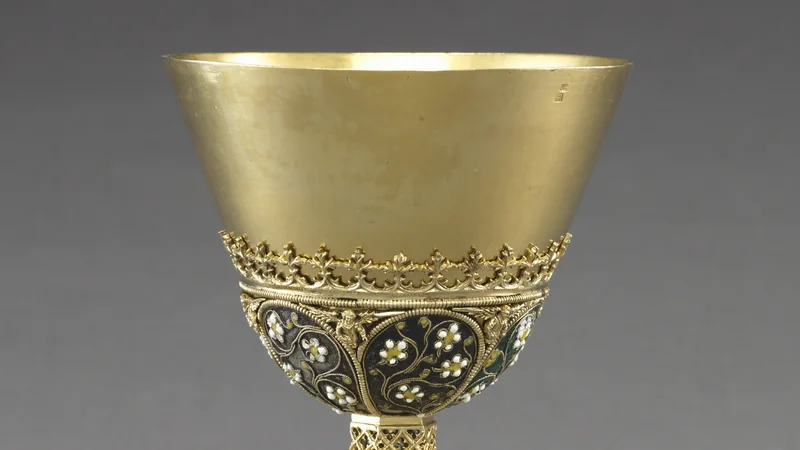
Artwork and usage rights
Local WebP reproduction, cropped to fit the page.