
Bishops · Church Fathers · Teachers
Saint Ambrose of Milan
Ambrose moved from imperial administration into the episcopate of Milan in the fourth century. His preaching, writing, and public disputes shaped Latin Christianity, and Augustine's own testimony gives an unusually close witness to part of his ministry.
- Feast day
- December 7
- Commemoration
- Catholic & Eastern Orthodox
- Region
- Italy
- Lifetime
- Approximately AD 340–397
The life & witness
Who was Saint Ambrose of Milan?
Chapter 01 · Church accounts
A Roman education and public office
Vatican News places Ambrose's birth around 340 in a Roman Christian family at Trier, while the OCA life describes his father as a Roman prefect and his later education in Rome. Both accounts place him in imperial administration before he became bishop. The sources reviewed do not offer an autobiography of his childhood. A story about bees settling on the infant Ambrose belongs to later hagiography, not a secure prediction of his career. What is clear in both Church accounts is that he entered ecclesiastical leadership from a position of civil responsibility. [1] [2]
Chapter 02 · Episcopal election account
An unexpected bishop in Milan
When Milan's bishop died in 374, rival Christian groups disputed the succession. Ambrose, then a city official and still a catechumen according to the OCA account, intervened to keep peace. The crowd called for him to become bishop. He initially resisted, then was baptized and consecrated. The episode reveals the political and theological tensions of the period and the unusual speed of his transition from lay administrator to bishop. Individual dramatic details of the acclamation are preserved by later narratives. [2] [1]
Chapter 03 · Primary writings and testimony
Preaching, writing, and the life of the Church
Ambrose taught in sermons and substantial theological works, including writings on Christian conduct and on faith. Augustine, who heard him in Milan, later described the force of Ambrose's preaching in the Confessions. Ambrose defended Nicene teaching in an empire where Christian doctrine remained contested, and the OCA life recalls his refusal to surrender a Milan basilica to an Arian court faction. He also helped shape local worship and hymnody. His surviving works and Augustine's testimony provide more direct evidence for his ministry than the wonders attached to his childhood. [4] [3] [2]
Chapter 04 · Church accounts of a public confrontation
Theodosius and moral accountability
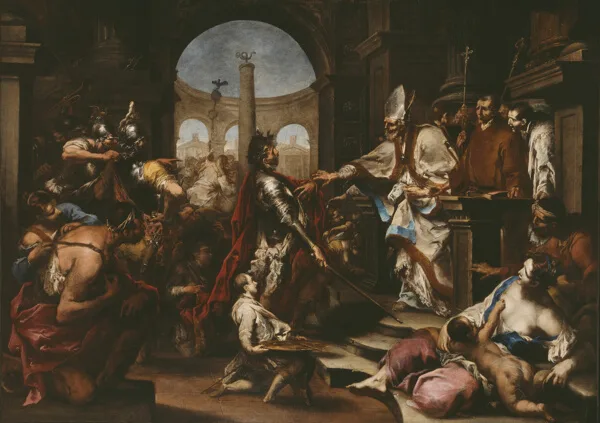
Both Church accounts remember Ambrose challenging Emperor Theodosius after a massacre at Thessalonica and calling for repentance. The episode became a lasting example of a bishop speaking about public wrongdoing to imperial power. Its familiar dialogue and ceremonial details require care because they come through accounts written and retold at different times. The basic significance is not a miracle claim: it is the remembered insistence that rulers, too, are subject to moral judgment. [1] [2]
Chapter 05 · Legacy and commemoration
Death and a shared Christian teacher
Ambrose died in 397 after more than two decades as bishop of Milan. His writings, preaching, and remembered role in Augustine's conversion continued to shape Western theology and worship. The Catholic Church calls him a Doctor of the Church; the OCA remembers him as Bishop of Milan. Both cited calendars commemorate him on December 7. His life is unusually well connected to surviving writings, though the precise origin of individual miracle stories and hymns attributed to him still requires separate source checking. [1] [2] [3]
Church calendars
How the churches remember Ambrose of Milan
These entries describe the named calendar sources below; they do not claim to survey every local church.
Catholic
In the Catholic Church
Catholic Church · Vatican News calendar
Commemorated December 7 · Date as listed in the Vatican News English calendar.
Calendar record [1]
Eastern Orthodox
In the Eastern Orthodox Church
Orthodox Church in America
Commemorated December 7 · Fixed date as listed by the OCA. Civil observance may differ in communities using the Julian calendar..
Calendar record [2]
Devotional memory
Miracles & traditions
These accounts belong to Christian tradition. Their details are not presented as independently established events.
Later hagiographical omen
Bees and the infant Ambrose
The OCA life tells of bees settling on the infant's face and leaving honey. This is a symbolic story about the sweetness of his future speech, not an independently verifiable childhood event. [2]
Devotional reading
Prayer & devotion
Prayer for wisdom with Saint Ambrose
Original composition · Christian prayer drawing on Ambrose's shared commemoration
Lord Jesus Christ, give your Church teachers who love truth and serve with humility. As Ambrose taught, preached, and called the powerful to account, help us join conviction with compassion. Through his prayers, strengthen our worship, our care for the poor, and our courage to repent when we have done wrong. Amen.
East & West Devotions · original devotional prayer
Research notes
Historical sources
References are linked to the chapters and calendar claims they support. A devotional account is distinguished from an independent historical record.
Artwork & rights
Theodosius Repulsed from the Church by Saint Ambrose, Alessandro Magnasco. Art Institute of Chicago. · Public domain (Art Institute of Chicago Open Access, CC0). View the source and rights record. This is a later artistic depiction, not a portrait from life.
Continue reading
Related saints & chapters
Published 2026-11-21 · Record reviewed 2026-11-21. Dates describe editorial review, not verification of every biographical claim.