
Church Fathers · Bishops · Theologians
Saint Augustine of Hippo
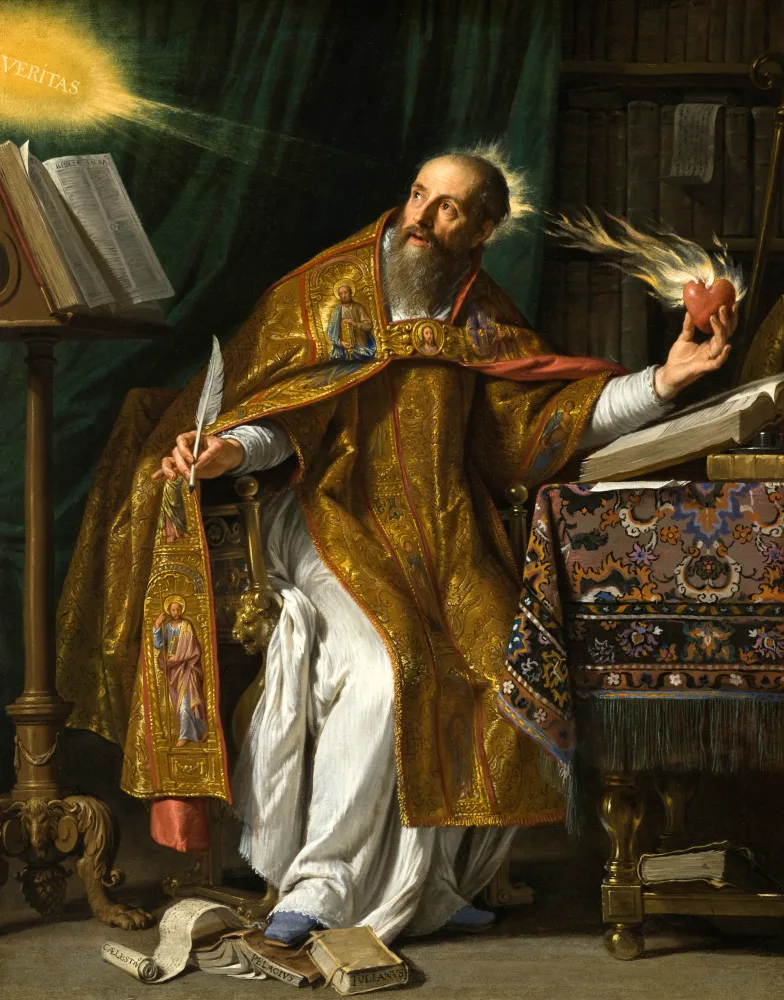
Augustine taught rhetoric before becoming bishop of Hippo in Roman North Africa. His Confessions follows a man who could explain words professionally long before he knew how to act on what he believed.
- Feast day
- August 28 · June 15
- Commemoration
- Catholic & Eastern Orthodox
- Region
- Roman North Africa
- Lifetime
- 354–430
The life & witness
Who was Saint Augustine of Hippo?
Chapter 01
From Thagaste to Milan
Born in 354 at Thagaste, Augustine grew up with his Christian mother Monica and studied at Carthage. His path ran through the Manichaean movement and a career in rhetoric. In Milan he listened to Bishop Ambrose. Augustine remembers that learning to read Scripture differently mattered as much to his conversion as the attraction of an accomplished preacher. [1] [2]
Chapter 02
A turning point in the garden
In book VIII of the Confessions, Augustine describes the shame of wanting to change and repeatedly postponing it. In a garden with his friend Alypius nearby, he hears a childlike voice and opens Paul’s letters. He reads a passage from Romans as a summons to act. The account is his own later, prayerful recollection. Book IX records his baptism with Alypius and his son Adeodatus in Milan. [3] [4]
Chapter 03
A bishop at Hippo
After returning to North Africa, Augustine became a priest and then bishop at Hippo. His ministry included frequent preaching, support for the poor, and the formation of clergy. His books addressed questions about grace, the Church, and the relation of earthly society to God’s city. He died in Hippo in 430 during the Vandal siege. [1] [2]
Chapter 04
Memory as prayer
Augustine addresses the Confessions to God, even when he describes people, books, or arguments. At the death of Monica he records both his grief and his prayer for her. The movement from memory to prayer gives a reader a way into a demanding book. A remembered kindness or failure can become an occasion for gratitude, repentance, or intercession. [4]
Chapter 05 · Historical record
The final years at a besieged city
Augustine's last years were neither private retirement nor uninterrupted writing. In 426 he presented the priest Heraclius as the intended successor at Hippo, hoping to devote more time to Scripture. He continued correspondence and disputes while political violence shook North Africa. Vandal forces besieged Hippo in 430, and Augustine died during the siege. A Vatican account draws on the early biography by Possidius for these events. The scene places his theological work in a community facing fear and displacement, not simply in a study separated from public life. [6]
Church calendars
How the churches remember Augustine of Hippo
These entries describe the named calendar sources below; they do not claim to survey every local church.
Catholic
In the Catholic Church
Roman Rite · United States
Commemorated August 28 · Gregorian calendar..
The Roman Rite honours Augustine as bishop and Doctor of the Church.
Calendar record [5]
Eastern Orthodox
In the Eastern Orthodox Church
Orthodox Church in America
Commemorated June 15 · Fixed liturgical date as listed by the OCA. Its civil date depends on the parish calendar..
The OCA names him Blessed Augustine, Bishop of Hippo, and commemorates him among the saints.
Calendar record [2]
Devotional reading
Prayer & devotion
Prayer for conversion with Saint Augustine
Original composition · Shared Christian commemoration
Lord Jesus Christ, you know the restless heart and receive those who turn toward you. Give us honesty about our failures, patience for the work of change, and love for your truth. Through the prayers of Saint Augustine, guide our memory, learning, and desire toward you. Amen.
East & West Devotions · original devotional prayer
The June hymn honours Augustine as a teacher of repentance and asks, “Intercede with the Lord, that He may have mercy on our souls.”
Read the source: OCA · June 15 troparion, Tone 4Research notes
Historical sources
References are linked to the chapters and calendar claims they support. A devotional account is distinguished from an independent historical record.
Artwork & rights
Saint Augustine, Los Angeles County Museum of Art. Reproduction via Wikimedia Commons. · Public domain. View the source and rights record. This is a later artistic depiction, not a portrait from life.
Continue reading
Related saints & chapters

Published 2026-11-10 · Record reviewed 2026-11-21. Dates describe editorial review, not verification of every biographical claim.