
Church Fathers · Bishops · Monastics · Theologians
Saint Basil the Great
Basil joined close study of the Holy Spirit to practical questions about life in community. In Caesarea, the care of hungry people, travellers, and the sick became part of the public work of a bishop.
- Feast day
- January 2 · January 1 · January 30
- Commemoration
- Catholic & Eastern Orthodox
- Region
- Cappadocia
- Lifetime
- About 330–379
The life & witness
Who was Saint Basil the Great?
Chapter 01
A Cappadocian family
Born into a Christian family, Basil received an education in rhetoric and studied in Athens, where he formed a friendship with Gregory of Nazianzus. After his return, his sister Macrina’s example helped turn him towards ascetic life. A period of travel introduced him to monastic communities whose practices he could examine at first hand. [1] [2]
Chapter 02
Learning to live with others
Basil understood common life as an opportunity to practise the Gospel commandments. A person living among brothers or sisters can receive correction, care for a sick neighbour, and put gifts to the service of the group. His teaching reached beyond Greek-speaking communities. Benedict directed readers of his own Rule to Basil’s work. [1]
Chapter 03
A bishop answers a question about prayer
Basil became bishop of Caesarea in 370. His treatise On the Holy Spirit opens with a disagreement about the language used to glorify God. Writing to Amphilochius, Basil turns to the practice of baptism in the name of Father, Son, and Holy Spirit. The Church’s worship gives him evidence for explaining the Spirit’s divine dignity. [1] [3]
Chapter 04
A place for the sick
Basil’s work in Caesarea included feeding people in a time of scarcity and establishing a complex that served travellers, the poor, and the sick. His example placed organised hospitality among the duties of Christian leadership. Orthodox worship remembers Basil alongside two other preachers on the January feast of the Three Hierarchs. [1] [4]
Chapter 05 · Church teaching and history
Worship, conflict, and his last years
Basil's teaching about the Holy Spirit grew out of lived worship as well as controversy. His defense of giving glory to the Spirit with the Father and the Son answered opponents who treated the Spirit as lesser. He also wrote letters seeking to mend divisions among bishops and communities. A Vatican account connects his organization of prayer and psalmody with his concern for the sick and poor. Basil died in 379, before the Council of Constantinople restated the Church's confession concerning the Spirit. The liturgy associated with his name and his charitable institutions preserve different dimensions of one episcopal life; neither should replace the other. [1] [7]
Church calendars
How the churches remember Basil the Great
These entries describe the named calendar sources below; they do not claim to survey every local church.
Catholic
In the Catholic Church
Roman Rite · United States
Commemorated January 2 · Gregorian calendar..
The Roman calendar brings Basil and Gregory together in one memorial as bishops and Doctors of the Church.
Calendar record [5]
Eastern Orthodox
In the Eastern Orthodox Church
Orthodox Church in America
Commemorated January 1 · Fixed liturgical date as listed by the OCA. Its civil date depends on the parish calendar..
Basil is also honoured with Gregory the Theologian and John Chrysostom on January 30.
Calendar record [2]
Catholic
In the Catholic Church
Ukrainian Greek Catholic Church
Commemorated January 30 · 2026 new-style calendar, Byzantine rite..
The Three Holy Hierarchs are commemorated together: Basil the Great, Gregory the Theologian, and John Chrysostom.
Calendar record [6]
Devotional reading
Prayer & devotion
Prayer for mercy with Saint Basil
Original composition · Shared Christian commemoration
Lord Jesus Christ, you meet us in the hungry, the sick, and the stranger. Teach us to unite prayer with practical care, as Basil sought to do. Through his prayers, make our communities places of hospitality, wise teaching, and generous service. Amen.
East & West Devotions · original devotional prayer
The feast hymn asks Basil to “entreat Christ God that our souls may be saved.”
Read the source: OCA · January 1 troparion, Tone 1Research notes
Historical sources
References are linked to the chapters and calendar claims they support. A devotional account is distinguished from an independent historical record.
Artwork & rights
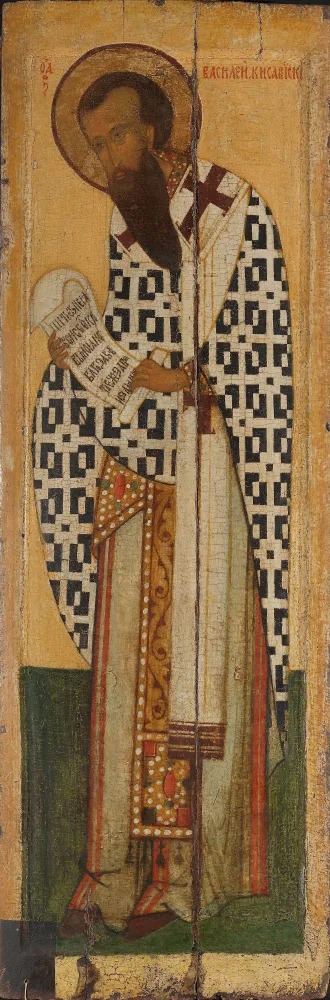
Saint Basil the Great, NG.M.01523, National Museum of Art, Architecture and Design, Norway. Reproduction via Wikimedia Commons. · Public domain. View the source and rights record. This is a later artistic depiction, not a portrait from life.
Continue reading
Related saints & chapters

Published 2026-11-10 · Record reviewed 2026-11-21. Dates describe editorial review, not verification of every biographical claim.