
Bishops · Missionaries
Saint Patrick of Ireland
Patrick's own writings describe a youth carried captive to Ireland, a return home, and a later mission among the Irish. They provide an unusually direct witness to a fifth-century Christian bishop, while many familiar stories about him arose later.
- Feast day
- March 17
- Commemoration
- Catholic & Eastern Orthodox
- Region
- Ireland
- Lifetime
- Fifth century; year of death uncertain
The life & witness
Who was Saint Patrick of Ireland?
Chapter 01 · Patrick's own testimony
Family and captivity
In his Confessio Patrick identifies his father Calpornius as a deacon and his grandfather Potitus as a priest. He says his home was near Bannavem Taburniae, whose location remains disputed. Raiders took him captive at about sixteen and brought him to Ireland. Patrick presents the captivity as a turning point in faith: isolated from his family, he began to pray and interpreted his endurance through his relationship with God. His own account gives much more secure evidence for these experiences than later legends about his childhood. [1]
Chapter 02 · Confessio
Escape and a call to return
Patrick says he remained in captivity for six years. After dreams that he took as divine guidance, he escaped and traveled a long distance to a ship. He describes hunger and difficulty during the journey, followed by reunion with his family in Britain. Later he dreamed that someone from Ireland brought him a letter calling him back. Patrick says the memory moved him deeply and that, after many years, he returned. The exact route, dates, and location of the dream's place-name are uncertain; these are the experiences as Patrick himself chose to recount them. [1]
Chapter 03 · Confessio and Letter
Bishop and missionary among the Irish
Patrick's writings show him serving as a bishop, preaching, baptizing, and caring for new Christian communities in Ireland. He stresses that he stayed among people once associated with his captivity because he believed Christ had called him to serve them. He also records criticism from fellow Christians about an earlier sin and defends the integrity of his mission. In his Letter to the Soldiers of Coroticus he condemns the killing and enslavement of newly baptized Christians. The letter gives a concrete glimpse of the dangers faced by converts and of Patrick's pastoral advocacy for them. [1] [2]
Chapter 04 · First-person witness and later legend
Prayer, visions, and later stories
The Confessio includes Patrick's reports of dreams, spiritual struggle, and divine help. He tells of companions finding food after he urged them to trust God. These are first-person religious claims within his own testimony, not events independently corroborated by the surviving record. Popular stories that he drove snakes from Ireland or used a shamrock to explain the Trinity do not appear in the two writings cited here and should not be presented as documented incidents in his life. [1]
Chapter 05 · Legacy and calendars
An uncertain ending and lasting mission
Patrick's own writings do not give a detailed death scene or a secure year of death. The OCA account notes that the year is disputed and commemorates him as Bishop of Armagh and Enlightener of Ireland. Catholic and OCA calendars remember him on March 17. His historical legacy is visible especially in the two writings that preserve his voice: they show a missionary explaining his calling, defending vulnerable converts, and attributing the growth of the Church in Ireland to God's grace rather than to his own status. [1] [2] [3] [4]
Church calendars
How the churches remember Patrick of Ireland
These entries describe the named calendar sources below; they do not claim to survey every local church.
Catholic
In the Catholic Church
Catholic Church · Vatican News calendar
Commemorated March 17 · Date as listed in the Vatican News English calendar.
Calendar record [3]
Eastern Orthodox
In the Eastern Orthodox Church
Orthodox Church in America
Commemorated March 17 · Fixed date as listed by the OCA. Civil observance may differ in communities using the Julian calendar..
Calendar record [4]
Devotional memory
Miracles & traditions
These accounts belong to Christian tradition. Their details are not presented as independently established events.
Patrick's first-person religious testimony
Food on the journey
Patrick says that, when a traveling company lacked food, he encouraged its members to turn to God and a herd of pigs appeared. The event is described by Patrick himself in the Confessio; the surviving record does not provide an independent account of the journey. [1]
Devotional reading
Prayer & devotion
Prayer for faithful witness with Saint Patrick
Original composition · Christian prayer drawing on Patrick's shared commemoration
Lord Jesus Christ, you sustained Patrick in captivity and called him to serve the people among whom he had suffered. Give us patience in hardship, courage to protect the vulnerable, and humility when we speak of faith. Through the prayers of Saint Patrick, guide us toward mercy and faithful witness. Amen.
East & West Devotions · original devotional prayer
Research notes
Historical sources
References are linked to the chapters and calendar claims they support. A devotional account is distinguished from an independent historical record.
- Patrick · Confessio, Royal Irish Academy edition and McCarthy translation (first-person testimony)
- Patrick · Letter to the Soldiers of Coroticus, Royal Irish Academy edition and McCarthy translation
- Vatican News · St. Patrick, Bishop, Disciple of Ireland
- Orthodox Church in America · Saint Patrick, Bishop of Armagh, Enlightener of Ireland
Artwork & rights
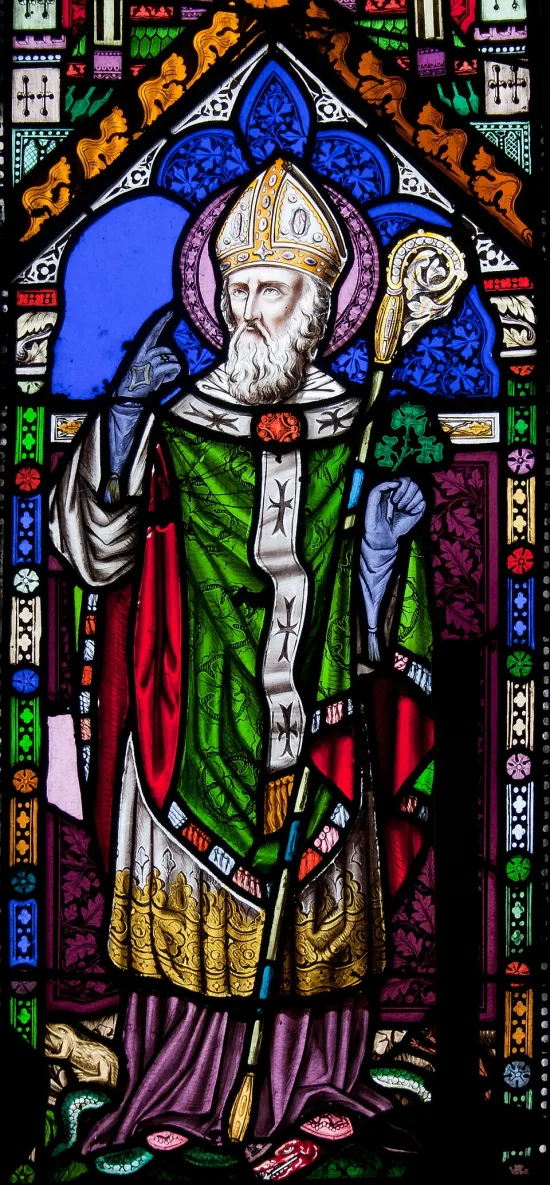
Our Lady's Island Church of the Assumption East Aisle Window Saint Patrick 2010 09 26.jpg. Wikimedia Commons. Resized and converted to WebP. · CC BY-SA 4.0. View the source and rights record. This is a later artistic depiction, not a portrait from life.
Continue reading
Related saints & chapters

Published 2026-11-21 · Record reviewed 2026-11-21. Dates describe editorial review, not verification of every biographical claim.