
Church Fathers · Monastics · Theologians
Saint John of Damascus
John of Damascus was an eighth-century Christian theologian and hymn writer whose defense of sacred images became influential during iconoclasm. His work connects the Christian East and West, while some episodes of his life survive only in later hagiography.
- Feast day
- December 4
- Commemoration
- Catholic & Eastern Orthodox
- Region
- Syria and Palestine
- Lifetime
- Seventh–eighth centuries
The life & witness
Who was Saint John of Damascus?
Chapter 01 · Church accounts and limits
A Christian family in Damascus
John lived under early Islamic rule in Damascus. Catholic and Orthodox accounts connect his family with civic administration there. The exact year of his birth, details of his schooling, and the order of his public offices are not established with the same certainty as his surviving writings. Later narratives describe a stepbrother and a learned teacher; these should not be turned into a detailed childhood scene without additional evidence. His position outside the Byzantine Empire later shaped the circumstances in which he wrote about icons. [2] [3]
Chapter 02 · Theological writings
Defending holy images
When Byzantine rulers opposed the veneration of images, John wrote defenses of icons. His argument distinguished the worship due to God from honor shown through an image and drew on the claim that the Son of God truly became visible in human flesh. These writings addressed a disputed practice that reached into Christian worship, teaching, and art. His defense helped shape the theological setting in which the Second Council of Nicaea later addressed images, though he died before that council met in 787. [1] [3] [2]
Chapter 03 · Later life and surviving work
Monastic life and a body of teaching
Church accounts describe John leaving public administration for the monastery of Saint Sabas near Jerusalem. There he is remembered for theology, poetry, and hymns. The OCA names his Fount of Knowledge, whose section On the Orthodox Faith brought earlier doctrinal material into a systematic exposition. A story that he was assigned humiliating tasks by an elder teaches obedience, but its staged details belong to hagiography. His written works offer stronger evidence for his intellectual and spiritual concerns than that story alone. [3] [2]
Chapter 04 · Miracle in Orthodox tradition
A severed hand and later devotion
The OCA life recounts a forged letter, a caliph's order that John's hand be cut off, and a healing after he prayed before an icon of the Mother of God. It links this story with the icon known as Of the Three Hands. The account is important in icon devotion but is not established by a contemporary medical or court record. It should be read separately from John's extant theological defense of images, which is a direct witness to his teaching. [3]
Chapter 05 · Legacy and calendars
Death and veneration across traditions
The OCA life places John's death around 780, though exact chronology in the later narrative remains uncertain. Vatican News commemorates him as a priest and Doctor of the Church; the OCA calls him Venerable John of Damascus. Both cited calendars list December 4. His lasting influence rests in the defense of icons, theological synthesis, and liturgical poetry associated with his name. Catholic and Orthodox readers can honor that contribution while distinguishing his surviving writings from later miracle stories. [2] [3]
Church calendars
How the churches remember John of Damascus
These entries describe the named calendar sources below; they do not claim to survey every local church.
Catholic
In the Catholic Church
Catholic Church · Vatican News calendar
Commemorated December 4 · Date as listed in the Vatican News English calendar.
Calendar record [2]
Eastern Orthodox
In the Eastern Orthodox Church
Orthodox Church in America
Commemorated December 4 · Fixed date as listed by the OCA. Civil observance may differ in communities using the Julian calendar..
Calendar record [3]
Devotional memory
Miracles & traditions
These accounts belong to Christian tradition. Their details are not presented as independently established events.
Later Orthodox hagiography
The restored hand
The OCA life relates that John's severed hand was restored after prayer before an icon of the Mother of God. This is a devotional miracle account, not independently verified surgery or a contemporary court record. [3]
Devotional reading
Prayer & devotion
Prayer for faithful images with Saint John of Damascus
Original composition · Shared Christian commemoration
Lord Jesus Christ, you truly became visible in our human life. Through the prayers of Saint John of Damascus, help us use words and images with reverence, remember the truth of your Incarnation, and never confuse a work of art with the God it calls us to worship. Amen.
East & West Devotions · original devotional prayer
Research notes
Historical sources
References are linked to the chapters and calendar claims they support. A devotional account is distinguished from an independent historical record.
Artwork & rights
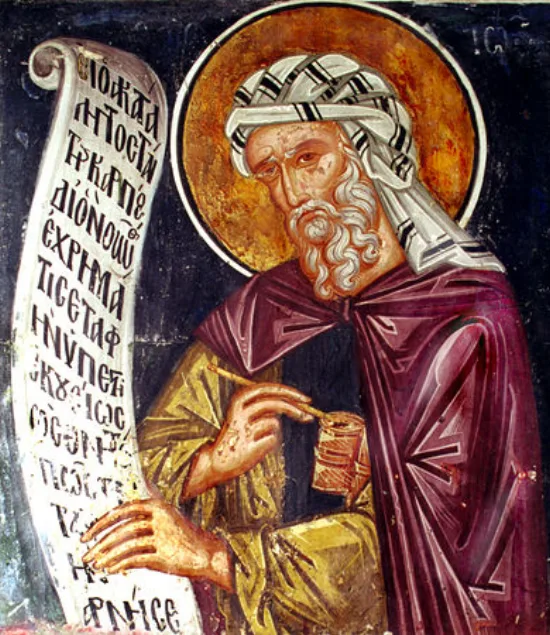
Athonite Fresco Icon of Saint John of Damascus.jpg. Wikimedia Commons. Resized and converted to WebP. · Public domain. View the source and rights record. This is a later artistic depiction, not a portrait from life.
Continue reading
Related saints & chapters

Published 2026-11-21 · Record reviewed 2026-11-21. Dates describe editorial review, not verification of every biographical claim.