
Bishops · Martyrs
Saint Philip of Moscow
Philip of Moscow (born Theodore Kolychev) was a Solovki monk and metropolitan who opposed the violence of Ivan IV's oprichnina. Orthodox tradition remembers him as a hieromartyr; some dramatic details of his confrontation survive through later Church narrative.
- Feast day
- January 9
- Commemoration
- Eastern Orthodox
- Region
- Russia
- Lifetime
- Sixteenth century; born 1507
The life & witness
Who was Saint Philip of Moscow?
Chapter 01 · Church account
From the court to Solovki
The Orthodox Church in America dates Theodore Kolychev's birth to 1507 in a noble Moscow family and describes his education for service at court. Its life says he left Moscow in 1537 and entered the Solovki monastery on the White Sea, where he received the name Philip. The specific inner thoughts and conversations assigned to his youth belong to a later hagiographical account. What matters to the historical outline is the change from a possible political career to monastic work, worship, and formation. [1]
Chapter 02 · Church leadership
Abbot and metropolitan
Philip became abbot of Solovki in 1546. The Church account credits him with strengthening its rule and helping build churches, including those dedicated to the Dormition and the Transfiguration. Ivan IV later called him to Moscow, and Philip was consecrated metropolitan in 1566. The appointment placed a monk formed in a large northern community near a ruler whose oprichnina used coercion and executions. Accounts of negotiations before his consecration should be read as the Church's explanation of the moral conflict, not as a verbatim transcript. [1]
Chapter 03 · Martyrdom and evidence
Opposition, deposition, and death
The OCA life describes Philip publicly condemning the oprichniki's violence in 1568 and refusing to bless Ivan during a cathedral service. He was subjected to a Church trial, removed from office, and confined. Its account dates his death to December 23, 1569, at the Tver Otroch monastery and attributes the killing to Malyuta Skuratov. These particulars are preserved in the received narrative of his martyrdom; the profile does not present its reported speeches or private foreknowledge as independently authenticated eyewitness testimony. [1]
Chapter 04 · Orthodox commemoration
Veneration and historical meaning
Philip's remains were later transferred to Solovki and then Moscow. The Russian Church shifted his commemoration from the traditional date of his death to January 9, the date retained in the OCA calendar. His remembrance joins monastic and episcopal life to the question of how a Church leader responds to state violence. A separate comparison of contemporary sources and historical scholarship is still needed before assigning equal certainty to every scene in the later Life. No individual miracle is asserted here without a separately checked account. [1]
Church calendars
Documented commemoration of Philip of Moscow
These entries describe the named calendar sources below; they do not claim to survey every local church.
Eastern Orthodox
In the Eastern Orthodox Church
Orthodox Church in America
Commemorated January 9 · Fixed date as listed by the OCA. Civil observance may differ in communities using the Julian calendar..
Calendar record [1]
Only one Church’s commemoration has been documented in this record. This is not a claim that other churches do not remember this saint.
Devotional reading
Prayer & devotion
Prayer for courage with Saint Philip of Moscow
Original composition · Eastern Orthodox commemoration
Lord Jesus Christ, hear those who suffer under violence justified in the name of order or faith. Through the prayers of Saint Philip of Moscow, give Church leaders courage to defend the innocent, wisdom to resist cruelty, and humility before your judgment. Amen.
East & West Devotions · original devotional prayer
Research notes
Historical sources
References are linked to the chapters and calendar claims they support. A devotional account is distinguished from an independent historical record.
Artwork & rights
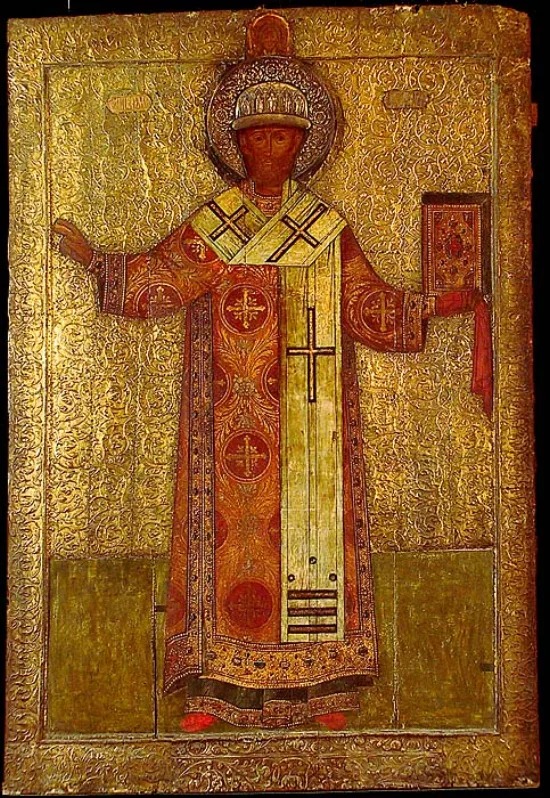
Philip Metropolitan of Moscow (icon).jpg. Wikimedia Commons. Resized and converted to WebP. · Public domain. View the source and rights record. This is a later artistic depiction, not a portrait from life.
Continue reading
Related saints & chapters

Published 2026-11-21 · Record reviewed 2026-11-21. Dates describe editorial review, not verification of every biographical claim.