
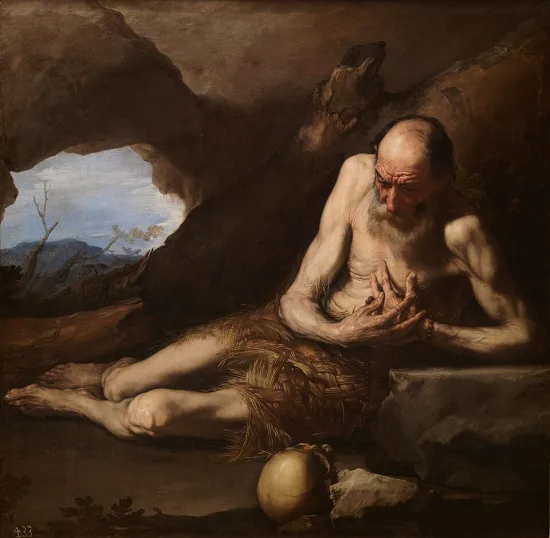
Monastics · Hermits
Saint Paul of Thebes
Paul of Thebes is remembered through Jerome's fourth-century Life as a desert hermit. The account shaped Christian monastic imagination, but little about Paul's independent historical biography can be securely recovered.
- Feast day
- January 15
- Commemoration
- Catholic & Eastern Orthodox
- Region
- Egypt
- Lifetime
- Third–fourth centuries in tradition
The life & witness
Who was Saint Paul of Thebes?
Chapter 01 · Source and historical limits
A figure known chiefly through Jerome
Jerome wrote the Life of Paul in the late fourth century, long after the events it narrates. He begins by discussing whether Anthony or Paul should be called the first hermit and admits that Paul's middle years are unknown. This frank limit matters: the Life is evidence for how late-fourth-century Christians understood desert holiness, while it supplies a much less secure basis for reconstructing the exact circumstances of Paul's birth, family, or decades in solitude. [1]
Chapter 02 · Jerome's narrative
Flight from danger into solitude
Jerome places Paul in Egypt during the persecutions of the third century. In his telling, danger and betrayal drove the young Christian into the desert, where a cave and a palm tree sustained him. His stay became a chosen life of prayer rather than a temporary hiding place. The story expresses a central monastic theme: withdrawal from ordinary security in order to seek God. Its precise dates, geography, and daily routine are not independently documented. [1] [2]
Chapter 03 · A literary and devotional episode
Anthony visits Paul
The best-known part of Jerome's account brings the elderly Anthony to Paul's dwelling. The two pray and share bread; Anthony later returns to find Paul dead and buries him. Jerome includes striking desert creatures and lions digging a grave. Those scenes should be read as features of the hagiographical account, not as independently verified observations. Their lasting power comes from the picture of mutual humility between two monks whom later Christians remembered as pioneers of desert life. [1] [3]
Chapter 04 · Church commemoration
Why the First Hermit is remembered
Catholic and Orthodox calendars remember Paul as a hermit. Vatican News states that very little is known about him, while the Orthodox Church in America retells the traditional life at greater length. Jerome himself describes a debate over priority, so 'First Hermit' is a devotional title rather than a securely established claim that no Christian lived as a solitary before him. His enduring significance lies in the ideal of sustained prayer in the desert. [1] [2] [3]
Church calendars
How the churches remember Paul of Thebes
These entries describe the named calendar sources below; they do not claim to survey every local church.
Catholic
In the Catholic Church
Catholic Church · Vatican News calendar
Commemorated January 15 · Date as listed in the Vatican News English calendar.
Calendar record [2]
Eastern Orthodox
In the Eastern Orthodox Church
Orthodox Church in America
Commemorated January 15 · Fixed date as listed by the OCA. Civil observance may differ in communities using the Julian calendar..
Calendar record [3]
Devotional memory
Miracles & traditions
These accounts belong to Christian tradition. Their details are not presented as independently established events.
Jerome describes miraculous provision and lions preparing Paul's grave. These belong to the fourth-century Life and are not independent eyewitness records. [1]
Devotional reading
Prayer & devotion
Prayer for trust with Saint Paul of Thebes
Original composition · Shared Christian commemoration
Lord Jesus Christ, meet those who pray in solitude and those who must find you amid noise. Through the prayers of Saint Paul of Thebes, teach us to depend on your care, welcome one another, and read ancient desert stories with both gratitude and discernment. Amen.
East & West Devotions · original devotional prayer
Research notes
Historical sources
References are linked to the chapters and calendar claims they support. A devotional account is distinguished from an independent historical record.
Artwork & rights
San Pablo Ermitaño, por José de Ribera.jpg. Wikimedia Commons. Resized and converted to WebP. · Public domain. View the source and rights record. This is a later artistic depiction, not a portrait from life.
Continue reading
Related saints & chapters

Published 2026-11-21 · Record reviewed 2026-11-21. Dates describe editorial review, not verification of every biographical claim.