
Monastics · Hermits
Saint Anthony the Great
Anthony of Egypt became one of the most influential witnesses to early Christian ascetic life. Athanasius's near-contemporary Life recounts both his withdrawal into the desert and his counsel to people who sought him there.
- Feast day
- January 17
- Commemoration
- Catholic & Eastern Orthodox
- Region
- Egypt
- Lifetime
- Approximately AD 251–356, according to Athanasius and later Church accounts
The life & witness
Who was Saint Anthony the Great?
Chapter 01 · Near-contemporary biography
An Egyptian Christian family
Athanasius, bishop of Alexandria, wrote Anthony's Life after knowing him and speaking with people close to him. He places Anthony's upbringing in a Christian Egyptian family with property. Athanasius says Anthony did not pursue formal schooling, but attended worship with his parents and listened closely to Scripture. After both parents died, Anthony cared for a younger sister. The Life gives his age then as about eighteen or twenty; its narrative is the principal source for these early details, not a civil birth record. [3]
Chapter 02 · Athanasius's account
A call heard in the Gospel
While reflecting on the apostles' sharing of possessions, Anthony heard the Gospel account of Jesus asking a wealthy man to give to the poor and follow him. Athanasius says Anthony understood this as a summons addressed to him. He disposed of his land, provided for his sister's care, and began learning from local ascetics. He supported himself by work while giving to people in need. The account presents this decision as a Christian calling rooted in Scripture, rather than a rejection of responsibility for his sister. [3]
Chapter 03 · Desert life and teaching
Solitude that became a ministry
Anthony first practiced asceticism near his village, then sought deeper solitude in the Egyptian desert. Athanasius describes struggles with fear, desire, and demonic temptations in vivid religious language. People nevertheless found their way to him. The long discourse in chapters 16–34 urges monks to persevere, discern thoughts, pray, and trust Christ. Later he lived farther into the desert, cultivated a small plot, and received visitors seeking counsel. His story shows how solitary prayer could also become service to a wider Christian community; Athanasius's portrait is a work of spiritual instruction as well as biography. [3] [2]
Chapter 04 · Claims within the Life
Healing stories and public witness
Athanasius reports that people sought Anthony's prayers for illness and distress. He recounts a girl said to have been healed after Anthony prayed, and he insists that healing belonged to Christ rather than to Anthony's own power. The Life also describes Anthony traveling to Alexandria and speaking against Arian teaching. These episodes belong to a text written by an admirer with a theological purpose. They document what Athanasius said about Anthony and his reputation, while individual cures cannot now be independently tested. [3]
Chapter 05 · Final years and commemoration
Death in the desert and a far-reaching legacy
In Athanasius's account Anthony told two attendants to bury him privately in the desert, resisting the display of his body. The same account says he left clothing to Athanasius and Serapion. Church records place his death in 356, though the precision of his reported age depends on the Life's chronology. Athanasius's book circulated widely and helped shape Christian monastic ideals in East and West. Catholic and Orthodox calendars both remember Anthony on January 17, while his lasting importance lies in the disciplined prayer, work, generosity, and spiritual counsel attributed to him. [3] [1] [2]
Church calendars
How the churches remember Anthony the Great
These entries describe the named calendar sources below; they do not claim to survey every local church.
Catholic
In the Catholic Church
Catholic Church · Vatican News calendar
Commemorated January 17 · Date as listed in the Vatican News English calendar.
Calendar record [1]
Eastern Orthodox
In the Eastern Orthodox Church
Orthodox Church in America
Commemorated January 17 · Fixed date as listed by the OCA. Civil observance may differ in communities using the Julian calendar..
Calendar record [2]
Devotional memory
Miracles & traditions
These accounts belong to Christian tradition. Their details are not presented as independently established events.
Report in Athanasius's Life
Healing through prayer
Athanasius describes Anthony praying for a girl afflicted with illness and says her family then found her well. The Life attributes the cure to Christ; it is a near-contemporary hagiographical report, not an independently verifiable medical record. [3]
Devotional reading
Prayer & devotion
Prayer for steadfastness with Saint Anthony
Original composition · Christian prayer drawing on Anthony's shared commemoration
Lord Jesus Christ, you called Anthony to follow you with an undivided heart. Teach us to pray with attention, work with generosity, and meet temptation with trust in you. Through the prayers of Saint Anthony, strengthen us to serve those who seek help and to remain faithful in quiet and in company. Amen.
East & West Devotions · original devotional prayer
Research notes
Historical sources
References are linked to the chapters and calendar claims they support. A devotional account is distinguished from an independent historical record.
Artwork & rights
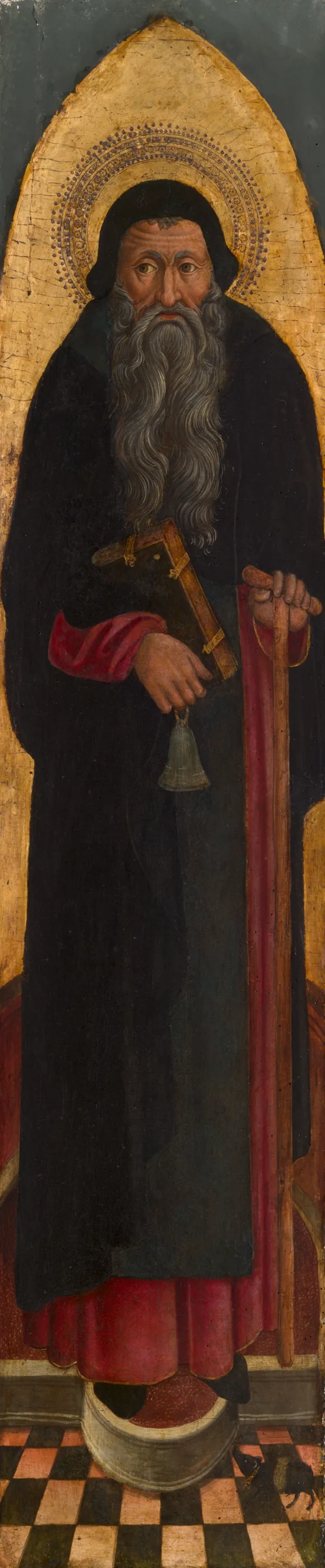
Panels from the Altarpiece of The Assumption of the Virgin with Saints: Saint Anthony Abbot, Italian. Art Institute of Chicago. · Public domain (Art Institute of Chicago Open Access, CC0). View the source and rights record. This is a later artistic depiction, not a portrait from life.
Continue reading
Related saints & chapters
Published 2026-11-21 · Record reviewed 2026-11-21. Dates describe editorial review, not verification of every biographical claim.