
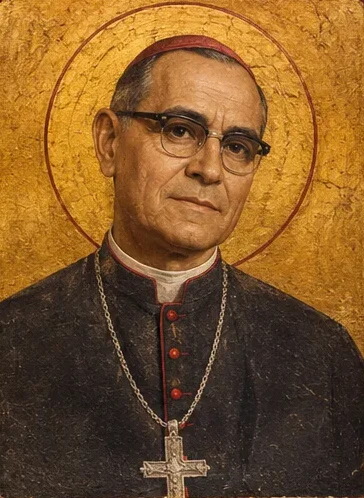
Bishops · Martyrs
Saint Óscar Romero
Óscar Romero, archbishop of San Salvador, used his homilies to name violence and defend the dignity of people in El Salvador. He was killed while celebrating Mass in 1980.
- Feast day
- March 24
- Commemoration
- Catholic
- Region
- El Salvador
- Lifetime
- Twentieth century; died 1980
The life & witness
Who was Saint Óscar Romero?
Chapter 01 · Life and setting
Priest and archbishop in El Salvador
Romero was born in 1917 and ordained a priest in 1942. He served in parish and diocesan roles before becoming archbishop of San Salvador in 1977. The country was marked by deep inequality, political repression, and armed conflict. Some accounts describe a dramatic conversion after the killing of his friend Rutilio Grande; the change in Romero's public leadership was real, but its development should be read through his sermons and actions rather than reduced to a single private moment. [3] [1]
Chapter 02 · Primary evidence
A public voice from the pulpit
Romero's surviving homilies document how he joined Scripture and the life of the Church to reports of disappearances, killings, and injustice. They addressed the actions of government forces, armed groups, and powerful interests. His diary also records meetings and responsibilities beyond the pulpit. These sources are stronger evidence for his teaching than unattributed slogans circulated online; exact quotations should always be checked against a dated homily or recording. [1] [2] [3]
Chapter 03 · Martyrdom
Death during Mass
On March 24, 1980, Romero was shot while celebrating Mass at a hospital chapel in San Salvador. His death became a symbol in a wider history of violence that claimed many lives. Catholic recognition names him a martyr; the Vatican canonized him in 2018. A biography should neither detach him from the people whose suffering he described nor use his death to claim that all political questions in El Salvador had simple answers. [3]
Chapter 04 · Catholic commemoration
Memory and responsible reading
His Catholic feast is March 24. His homilies remain available in English and Spanish, allowing readers to meet the full argument of a pastor rather than a collection of slogans. The site does not display a portrait until image rights are verified. His continuing relevance includes the relationship between Christian worship, truth-telling, and public responsibility, but specific modern political applications require argument rather than automatic endorsement in his name. [1] [3]
Church calendars
Documented commemoration of Óscar Romero
These entries describe the named calendar sources below; they do not claim to survey every local church.
Catholic
In the Catholic Church
Catholic Church · Vatican News calendar
Commemorated March 24 · Date as listed in the Vatican News English calendar.
Calendar record [3]
Only one Church’s commemoration has been documented in this record. This is not a claim that other churches do not remember this saint.
Devotional reading
Prayer & devotion
Prayer for justice with Saint Óscar Romero
Original composition · Catholic commemoration
Lord Jesus Christ, hear those who face violence for defending their neighbors. Through the prayers of Saint Óscar Romero, give courage to speak for the vulnerable, wisdom to reject hatred, and peace rooted in truth and justice. Amen.
East & West Devotions · original devotional prayer
Research notes
Historical sources
References are linked to the chapters and calendar claims they support. A devotional account is distinguished from an independent historical record.
Artwork & rights
Original devotional artwork created for East & West Devotions. This is an artistic depiction, not a portrait from life.
Continue reading
Related saints & chapters
Published 2026-11-21 · Record reviewed 2026-11-21. Dates describe editorial review, not verification of every biographical claim.