
Hermits · Women saints
Saint Mary of Egypt
Mary of Egypt is remembered through a later Christian Life as a woman who repented in Jerusalem and spent years in the desert. The account became a powerful teaching on repentance, but its precise chronology and extraordinary episodes cannot be independently reconstructed.
- Feast day
- April 2 · April 1
- Commemoration
- Catholic & Eastern Orthodox
- Region
- Palestine
- Lifetime
- Late antiquity; chronology uncertain
The life & witness
Who was Saint Mary of Egypt?
Chapter 01 · Later Life attributed to Sophronius
The story's setting and its limits
Mary's story survives as a hagiographical Life attributed to Sophronius of Jerusalem. It is framed through the monk Zosimas, who encounters her during a Lenten retreat. The Life says Mary came from Egypt, left her family young, and lived in Alexandria. Neither a contemporary birth record nor an independent account of her early years is available in the sources reviewed here. The story's purpose is to show that repentance and God's mercy are possible even after a long period of wrongdoing; its narrative details should be identified as the claims of the Life. [2] [1]
Chapter 02 · Hagiographical narrative
A turning point in Jerusalem
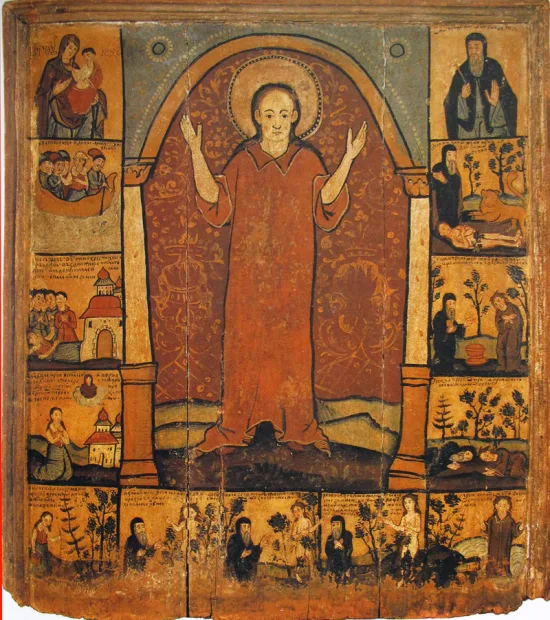
In the Life, Mary joins people traveling to Jerusalem for the feast of the Exaltation of the Cross. At the church she repeatedly finds herself unable to enter and recognizes a need to change her life. She prays before an image of the Mother of God, enters to venerate the Cross, and then resolves to leave her former way of life. The text describes this as a conversion rooted in repentance and divine mercy. It is a theological narrative preserved by later Christian tradition, not a separately documented report of what happened at the doorway. [2]
Chapter 03 · Ascetic tradition
Years beyond the Jordan
The account says Mary crossed the Jordan after receiving the Eucharist and lived in the wilderness for decades. Speaking to Zosimas, she describes hunger, exposure, memories of her former life, and a long struggle to remain faithful to her vow. The traditional span of forty-seven desert years comes from this account. Her narrative does not portray repentance as instantaneous ease: it dwells on sustained effort, prayer, and the hope of mercy. The length of her solitude cannot be checked against independent records. [2] [1]
Chapter 04 · Later Life and extraordinary accounts
Zosimas and the final Eucharist
Zosimas's meeting with Mary gives the Life much of its shape. She recounts her past and asks him to return with the Eucharist. On the next visit, according to the text, she crosses the Jordan miraculously, receives Communion, and disappears into the desert. When Zosimas comes back a year later, he finds her dead and buries her; the Life says a lion helps dig the grave. These scenes speak to the tradition's view of Mary's holiness and the importance of the Eucharist, but they are not independently verified observations. [2]
Chapter 05 · Commemoration and legacy
A witness to repentance in East and West
The Life concludes by saying that Zosimas returned to his monastery and told its community what he had heard and seen; it attributes the written form to Sophronius, who says he received the story from earlier monks. Orthodox Christians remember Mary on April 1 in the OCA fixed calendar, while Vatican News lists her on April 2. The traditions differ in their calendar placement but honor her as a penitent. Her historical significance in Christian spirituality is the enduring use of her story to teach repentance, humility, and hope, even where the details of her individual life remain difficult to verify. [2] [1]
Church calendars
How the churches remember Mary of Egypt
These entries describe the named calendar sources below; they do not claim to survey every local church.
Catholic
In the Catholic Church
Catholic Church · Vatican News calendar
Commemorated April 2 · Date as listed in the Vatican News English calendar.
Calendar record [1]
Eastern Orthodox
In the Eastern Orthodox Church
Orthodox Church in America
Commemorated April 1 · Fixed date as listed by the OCA. Civil observance may differ in communities using the Julian calendar..
Calendar record [2]
Devotional memory
Miracles & traditions
These accounts belong to Christian tradition. Their details are not presented as independently established events.
Extraordinary event in the later Life
Walking across the Jordan
The Life says Zosimas saw Mary make the sign of the cross and cross the Jordan on foot to receive the Eucharist. This belongs to the hagiographical account and is not independently established. [2]
Extraordinary event in the later Life
The lion at the burial
When Zosimas could not dig a grave, the narrative says a lion appeared and dug the earth. The episode is part of the story's devotional portrayal of Mary's sanctity. [2]
Devotional reading
Prayer & devotion
Prayer for repentance with Saint Mary of Egypt
Original composition · Christian prayer drawing on Mary's shared commemoration
Merciful Lord Jesus Christ, no distance from you is too far for a heart that turns back. Give us honesty about our sins, perseverance in change, and hope in your forgiveness. Through the prayers of Saint Mary of Egypt, lead us from despair to repentance and from isolation to communion with you. Amen.
East & West Devotions · original devotional prayer
Research notes
Historical sources
References are linked to the chapters and calendar claims they support. A devotional account is distinguished from an independent historical record.
Artwork & rights
Марія Єгипетська з житієм. Українська ікона кінця XVII ст. Село Лісковате. - Mary of Egypt with her Life. Ukrainian icon, late 17th century. Liskovate village..jpg. Wikimedia Commons. Resized and converted to WebP. · CC BY-SA 4.0. View the source and rights record. This is a later artistic depiction, not a portrait from life.
Continue reading
Related saints & chapters

Published 2026-11-21 · Record reviewed 2026-11-21. Dates describe editorial review, not verification of every biographical claim.