
Martyrs · Women saints
Saint Agatha of Sicily
Agatha is remembered as a Sicilian virgin and martyr whose veneration took root in Catania. Her courage is celebrated in Catholic and Eastern Orthodox calendars; the dramatic details of her trial come from later Christian tradition.
- Feast day
- February 5
- Commemoration
- Catholic & Eastern Orthodox
- Region
- Sicily
- Lifetime
- Third century; martyrdom traditionally placed around AD 251
The life & witness
Who was Saint Agatha of Sicily?
Chapter 01 · Historical evidence and uncertainty
A Sicilian Christian remembered across centuries
The surviving evidence does not establish Agatha’s birth year, family, education, or exact birthplace. Catania and Palermo both appear in traditions about her origins: Vatican News describes the dispute between the two cities, while the Orthodox Church in America calls her Agatha of Palermo. Both traditions associate her martyrdom with Catania. Later accounts portray her as a young woman of means who chose a life consecrated to Christ, but those biographical details cannot be checked against a contemporary record. What can be traced more securely is the early Christian memory of a martyr named Agatha in Sicily. [1] [2] [5]
Chapter 02 · Later Passion and historical context
Faith in a time of persecution
Christian tradition places Agatha’s death during the persecution associated with Emperor Decius in the middle of the third century. In the later Passion, an official named Quintianus brings her before him, demands that she abandon her Christian commitment, and tries to make her submit to his wishes. Agatha refuses. The story presents her refusal as both a confession of faith and a defense of her dignity against coercion. The broad setting of Decian persecution is historical; the named official, the conversations, and the sequence of confrontations are details of a later hagiographical narrative, not a surviving court transcript. [1] [2] [5]
Chapter 03 · Hagiographical tradition
Imprisonment, suffering, and steadfastness
The Passion relates that Agatha was held in Catania and subjected to attempts to turn her from Christ. It describes severe torture, including the mutilation of her breasts. The same narrative says that the Apostle Peter appeared to her in prison and healed her wounds. Catholic and Orthodox retellings preserve these events as part of her devotional story. A modern study of the liturgical use of Agatha’s Passion notes that its dramatic dialogue, suffering, and healing also function as a theological narrative of deliverance. Their presence in the Passion does not independently establish the details of what happened in the prison. [1] [2] [5]
Chapter 04 · Tradition and early material witness
Death and the beginnings of veneration
Both Church accounts remember Agatha dying after her ordeal, still confessing Christ. The year 251 and the date February 5 are traditional; no contemporary eyewitness account of her final hours survives. Her memory, however, was established early in Catania. A fourth-century Christian funerary inscription from the city may invoke Agatha, although its final line is debated. Archaeological and epigraphic research describes veneration of Agatha and the martyr Euplius at Catania from at least the fourth century. These sources illuminate the growth of her cult without verifying every incident in the later Passion. [2] [3] [4] [5]
Chapter 05 · Later devotion and legacy
Catania, Mount Etna, and a lasting witness
A later account connects Agatha’s intercession with the protection of Catania from a flow of lava from Mount Etna. The episode is part of the city’s devotional memory and should not be treated as a securely dated eyewitness report. Agatha’s association with Catania endured in churches, liturgy, art, and the remembrance of her relics there. Her name continues to be read on February 5 in Catholic and Eastern Orthodox calendars. The different geographical titles used by those calendars show the diversity of tradition around one martyr, while their shared commemoration shows the reach of her witness. [1] [2] [4]
Church calendars
How the churches remember Agatha of Sicily
These entries describe the named calendar sources below; they do not claim to survey every local church.
Catholic
In the Catholic Church
Catholic Church · Vatican News calendar
Commemorated February 5 · Date as listed in the Vatican News English calendar.
Calendar record [1]
Eastern Orthodox
In the Eastern Orthodox Church
Orthodox Church in America
Commemorated February 5 · Fixed date as listed by the OCA. Civil observance may differ in communities using the Julian calendar..
Calendar record [2]
Devotional memory
Miracles & traditions
These accounts belong to Christian tradition. Their details are not presented as independently established events.
Account in the later Passion
Peter in the prison
The Passion and both Church retellings describe the Apostle Peter appearing to Agatha and healing her wounds. It is a devotional claim, not an independently attested event from her lifetime. [1] [2]
Local devotional tradition
Protection from Mount Etna
Vatican News recounts a tradition that Catania’s people sought Agatha’s intercession when lava threatened the city. The report belongs to later sacred memory; the historical sequence and date are not independently confirmed here. [1]
Devotional reading
Prayer & devotion
Prayer for steadfast faith with Saint Agatha
Original composition · Shared Christian commemoration
Lord Jesus Christ, refuge of those who suffer, hear people who face violence and humiliation. Through the prayers of Saint Agatha, strengthen their courage, move us to protect them, and let no one mistake endurance for permission to harm. Bring healing, justice, and peace. Amen.
East & West Devotions · original devotional prayer
Lord Jesus Christ, give us courage to remain faithful when we face fear or coercion. Help us protect the dignity of those who suffer, and remember your witnesses with humility. Amen.
Original devotional reflection · East & West Devotions
Research notes
Historical sources
References are linked to the chapters and calendar claims they support. A devotional account is distinguished from an independent historical record.
- Vatican News · St. Agatha, Virgin and Martyr (Catholic commemoration and later Passion)
- Orthodox Church in America · Martyr Agatha of Palermo in Sicily (February 5)
- I.Sicily · ISic000964, funerary inscription for Agathon (fourth century, debated invocation)
- C. Soraci · The Christianisation of Catania and the cult of the martyrs (2024)
- Vera Figura Sancti · Agatha in the Roman breviary and the later Passion (2025)
Artwork & rights
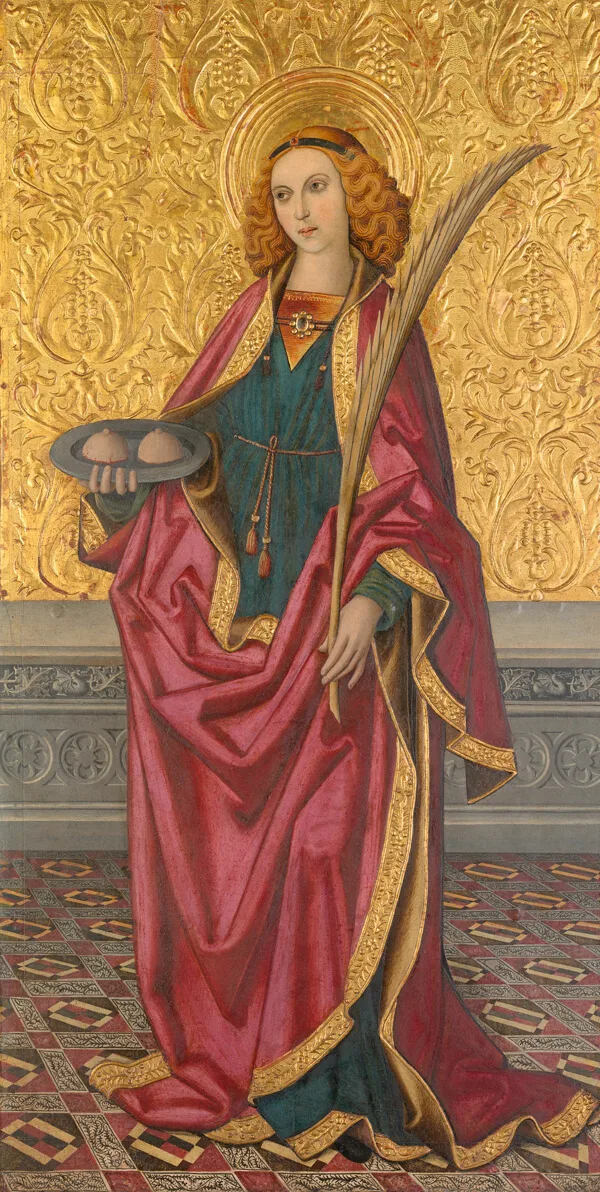
Saint Agatha, Vergós Workshop. Art Institute of Chicago. · Public domain (Art Institute of Chicago Open Access, CC0). View the source and rights record. This is a later artistic depiction, not a portrait from life.
Continue reading
Related saints & chapters
Published 2026-11-11 · Record reviewed 2026-11-13. Dates describe editorial review, not verification of every biographical claim.