
Missionaries · Priests
Saint Francis Xavier
Francis Xavier was an early Jesuit companion of Ignatius of Loyola who traveled through the Portuguese maritime world to serve Christian communities and preach in Asia.
- Feast day
- December 3
- Commemoration
- Catholic
- Region
- South and East Asia
- Lifetime
- Sixteenth century
The life & witness
Who was Saint Francis Xavier?
Chapter 01 · Foundation
From Paris to the first Jesuits
Born in Navarre in 1506, Xavier studied in Paris and joined the companions of Ignatius of Loyola. They were ordained and considered ways to offer their lives in mission. Xavier later became the first of their number sent to Asia. His story is inseparable from both the early Society of Jesus and sixteenth-century Portuguese expansion; the missionary journey depended on ships, patronage, and political authority as well as personal conviction. [1]
Chapter 02 · Mission and context
Goa and South Asian communities
Xavier reached Goa in 1542. The Jesuit account describes preaching, visits to prisoners and sick people, instruction of communities that already identified as Christian, and efforts to prepare local catechists. He relied on interpreters in settings where he did not know local languages well. Large baptism figures in older narratives should be attributed to their sources rather than treated as independently audited totals. The local Christians he met had histories that did not begin with his arrival. [1] [2]
Chapter 03 · Travels
Japan and plans for China
Xavier arrived in Japan in 1549 with companions, including Japanese Christian Anjirō. The Jesuit narrative describes his adaptation to local expectations, conversations with political leaders, and the founding of communities that others continued to serve. He later planned to enter China but died on Shangchuan Island in 1552 before doing so. His travels were extensive, but he did not reach every place to which later devotion associates his name. [1]
Chapter 04 · Catholic commemoration
Legacy and a fuller historical view
Xavier's feast is December 3. His letters and the Jesuit record made him a formative example of Catholic missionary life. A truthful account also keeps the colonial setting in view and avoids presenting Asian peoples as passive recipients of faith. Translators, catechists, and existing Christian communities mattered to the work. His courage and persistence can be described without claiming that every method or consequence of early modern mission was beyond criticism. [1] [2]
Church calendars
Documented commemoration of Francis Xavier
These entries describe the named calendar sources below; they do not claim to survey every local church.
Catholic
In the Catholic Church
Catholic Church · Vatican News calendar
Commemorated December 3 · Date as listed in the Vatican News English calendar.
Calendar record [3]
Only one Church’s commemoration has been documented in this record. This is not a claim that other churches do not remember this saint.
Devotional reading
Prayer & devotion
Prayer for humble mission with Saint Francis Xavier
Original composition · Catholic commemoration
Lord Jesus Christ, send us to meet our neighbors with humility and love. Through the prayers of Saint Francis Xavier, give us courage to witness to you, patience to learn from other cultures, and honesty about the harms entangled with colonial history. Amen.
East & West Devotions · original devotional prayer
Research notes
Historical sources
References are linked to the chapters and calendar claims they support. A devotional account is distinguished from an independent historical record.
Artwork & rights
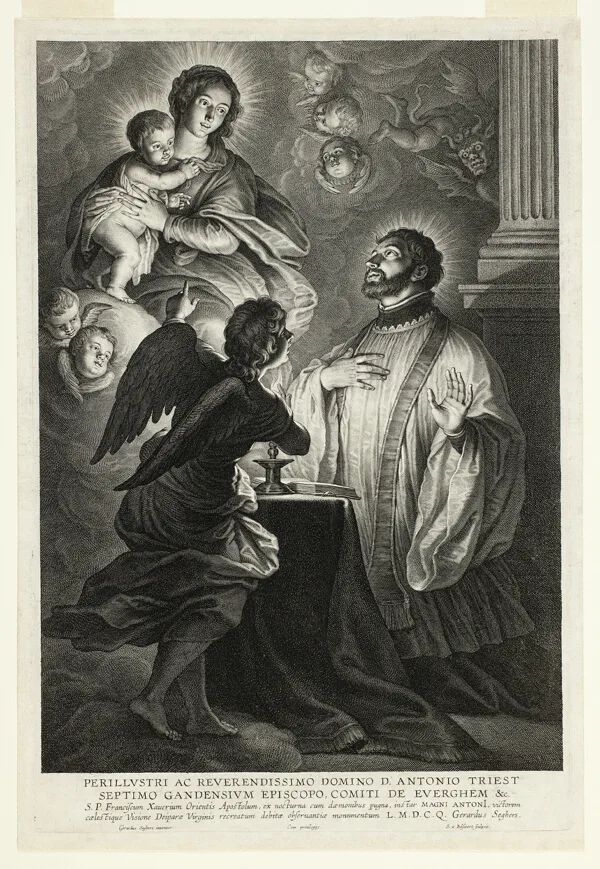
The Virgin and Child Appearing to Saint Francis Xavier, Schelte Adamsz. Bolswert. Art Institute of Chicago. · Public domain (Art Institute of Chicago Open Access, CC0). View the source and rights record. This is a later artistic depiction, not a portrait from life.
Continue reading
Related saints & chapters
Published 2026-11-21 · Record reviewed 2026-11-21. Dates describe editorial review, not verification of every biographical claim.