
Women saints · Franciscan penitents
Saint Angela of Foligno
Angela of Foligno was a widow and Franciscan penitent whose spiritual experiences were recorded in a book shaped through collaboration with a friar. Her life joins conversion, care, and the challenges of interpreting mystical testimony.
- Feast day
- January 4
- Commemoration
- Catholic
- Region
- Italy
- Lifetime
- Thirteenth–fourteenth centuries
The life & witness
Who was Saint Angela of Foligno?
Chapter 01 · Early life
Family life and change
Angela lived in thirteenth-century Foligno and had a husband and children. The Vatican account describes a gradual movement away from a comfortable social life toward repentance and Christian service. It draws on the Book associated with her, whose narrative is spiritually purposeful. Exact dates and details of her earliest experiences should be held with appropriate caution rather than turned into a dramatic invented conversion scene. [1]
Chapter 02 · Later life
A Franciscan path after loss
After family bereavements, Angela associated with Franciscan penitents and adopted a life of prayer, simplicity, and care for others. This was not a withdrawal from all relationships: she gathered people seeking counsel. Her religious practices can seem severe to modern readers. They should be described in their medieval setting without prescribing them as a universal pattern of mental or physical health. [1]
Chapter 03 · Source and interpretation
The Book and its mediator
Her spiritual experiences were spoken to a Franciscan friar who wrote and organized them. The resulting Book of Visions and Instructions is therefore an indispensable witness, but it is not an unmediated diary in Angela's hand. Its account of stages of conversion and union with God should be read as theological testimony and edited text. This distinction protects the richness of her voice while making the source relationship honest. [1]
Chapter 04 · Catholic commemoration
Recognition and influence
Angela died in 1309 and remained influential in Catholic spiritual writing. She was canonized in 2013, after the 2010 Vatican audience that still called her Blessed. This changing title is a reason to attend to the date of a source. Her feast in the existing catalogue is January 4. A full review of her recognition record and the Book's textual history remains desirable before claiming comprehensive verification. [1] [2]
Church calendars
Documented commemoration of Angela of Foligno
These entries describe the named calendar sources below; they do not claim to survey every local church.
Catholic
In the Catholic Church
Catholic Church · Vatican News calendar
Commemorated January 4 · Date as listed in the Vatican News English calendar.
Calendar record [2]
Only one Church’s commemoration has been documented in this record. This is not a claim that other churches do not remember this saint.
Devotional reading
Prayer & devotion
Prayer for conversion with Saint Angela
Original composition · Catholic commemoration
Lord Jesus Christ, receive those who turn toward you through grief and uncertainty. Through the prayers of Saint Angela of Foligno, help us speak honestly about our lives, care for the poor, and test spiritual experiences with humility and wise counsel. Amen.
East & West Devotions · original devotional prayer
Research notes
Historical sources
References are linked to the chapters and calendar claims they support. A devotional account is distinguished from an independent historical record.
Artwork & rights
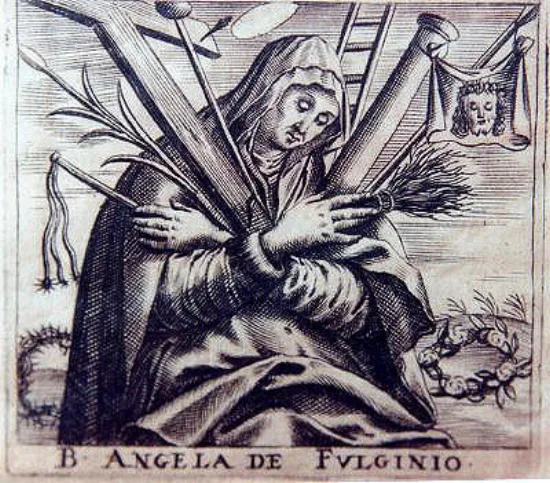
Angela of Foligno 1.jpg. Wikimedia Commons. Resized and converted to WebP. · Public domain. View the source and rights record. This is a later artistic depiction, not a portrait from life.
Continue reading
Related saints & chapters

Published 2026-11-21 · Record reviewed 2026-11-21. Dates describe editorial review, not verification of every biographical claim.