
Women saints · Women religious
Saint Josephine Bakhita
Josephine Bakhita was abducted and enslaved as a child in Sudan, later gained freedom in Italy, and became a Canossian sister. Her life must be told with care for both her agency and the violence she endured.
- Feast day
- February 8
- Commemoration
- Catholic
- Region
- Sudan and Italy
- Lifetime
- Nineteenth–twentieth centuries
The life & witness
Who was Saint Josephine Bakhita?
Chapter 01 · Historical testimony
Abduction and enslavement
Bakhita was born in Sudan in the nineteenth century. As a child she was abducted and sold into slavery more than once. The name Bakhita, meaning 'fortunate' in Arabic, was given during that period; her birth name and exact birth date are not securely known. Vatican accounts preserve the outline of her experience, but a biography should not invent details of particular assaults or turn her suffering into a decorative preface to a conversion story. [1] [2]
Chapter 02 · A changed legal and personal life
Italy, freedom, and baptism
She was brought to Italy, where her circumstances changed and she was able to remain with the Canossian sisters. An Italian legal ruling recognized that she was not property. After instruction in the Christian faith, she was baptized in 1890 and took the name Josephine. Her movement toward religious life was a decision made by a woman who had endured the denial of choice; the legal and human significance of freedom deserves as much attention as the later devotional portrait. [1] [2]
Chapter 03 · Community life
A Canossian sister in Schio
Bakhita made religious profession with the Canossians and served for years in community work, especially at Schio. She became known for patient kindness and witness, while remaining a person with an individual history rather than a symbol of generic endurance. Later accounts emphasize her forgiveness. This can be described as part of her own Christian response, never as a demand that survivors of abuse must forgive on a schedule. [1] [2]
Chapter 04 · Catholic commemoration
Death and recognition
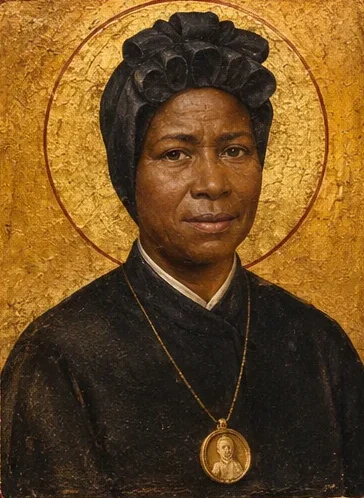
Bakhita died in 1947 and was canonized in 2000. The existing calendar records February 8 as her Catholic feast. Her witness invites attention to human dignity, freedom, and the ongoing reality of trafficking and enslavement. The profile retains an artwork placeholder because the rights and identity of a proposed portrait remain unresolved; the historic person should not be represented by an unverified image. [1] [2]
Church calendars
Documented commemoration of Josephine Bakhita
These entries describe the named calendar sources below; they do not claim to survey every local church.
Catholic
In the Catholic Church
Catholic Church · Vatican News calendar
Commemorated February 8 · Date as listed in the Vatican News English calendar.
Calendar record [3]
Only one Church’s commemoration has been documented in this record. This is not a claim that other churches do not remember this saint.
Devotional reading
Prayer & devotion
Prayer for freedom and dignity with Saint Josephine Bakhita
Original composition · Catholic commemoration
Lord Jesus Christ, defend every person against enslavement and exploitation. Through the prayers of Saint Josephine Bakhita, give survivors safety and healing, move us to resist injustice, and teach us to honor each person's freedom and dignity. Amen.
East & West Devotions · original devotional prayer
Research notes
Historical sources
References are linked to the chapters and calendar claims they support. A devotional account is distinguished from an independent historical record.
Artwork & rights
Original devotional artwork created for East & West Devotions. This is an artistic depiction, not a portrait from life.
Continue reading
Related saints & chapters
Published 2026-11-21 · Record reviewed 2026-11-21. Dates describe editorial review, not verification of every biographical claim.