
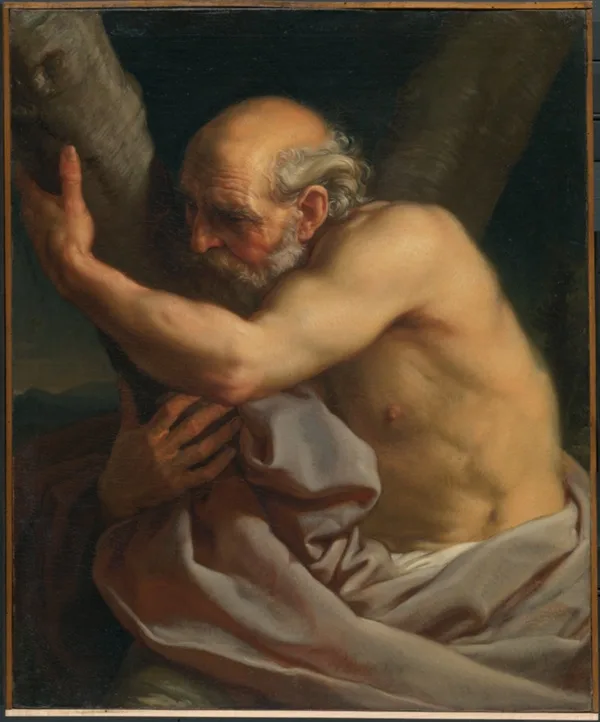
Apostles
Saint Andrew the Apostle
Andrew appears in the Gospels as Simon Peter's brother and an early follower of Jesus. Later Church traditions remember missionary journeys and martyrdom, but the New Testament does not narrate his death.
- Feast day
- November 30
- Commemoration
- Catholic & Eastern Orthodox
- Region
- Galilee
- Lifetime
- First century
The life & witness
Who was Saint Andrew the Apostle?
Chapter 01 · Gospel witness
A fisherman and brother of Simon
The Gospel traditions identify Andrew as Simon Peter's brother and place their work around the Sea of Galilee. John 1 describes Andrew first listening to John the Baptist, then following Jesus and bringing Simon to meet him. Matthew's list of the Twelve includes the brothers together. The texts do not give Andrew's birth year, parents' names, schooling, or a personal account of his childhood. The Orthodox title First-Called reflects the importance of John's sequence, not a claim that all Gospel call stories use identical chronology. [1] [4] [6]
Chapter 02 · Episodes in John's Gospel
Bringing others to Jesus
Andrew's introduction of Simon is his most familiar early action. John also names him when a boy's loaves and fish are brought to Jesus before the feeding of the crowd, and when Greek-speaking visitors seek an audience with Jesus. These scenes do not amount to a complete itinerary of his ministry, yet they show why Christian readers have long associated Andrew with invitation and witness. His role is presented within the company of disciples rather than as an independent founder with a documented travel log. [1] [2] [3]
Chapter 03 · Later Orthodox tradition
Mission beyond the Gospel record
After the Gospel narratives, the New Testament gives little detail about Andrew's individual travels. The OCA life describes journeys through regions around the Black Sea and honors him in connection with the apostolic heritage of Constantinople. These claims belong to later Church memory and should not be presented as a securely mapped first-century route. They matter because Eastern Christians understand Andrew as an apostolic witness whose memory reaches beyond Galilee and Judaea. [6]
Chapter 04 · Tradition and calendar
Death and later remembrance
Christian tradition holds that Andrew was martyred, but the Gospels and Acts do not state his date, location, method of death, or final words. Later accounts and art often show a distinctive cross, a detail that must be treated as tradition rather than New Testament testimony. Catholic and OCA calendars both commemorate him on November 30. The shared date honors a disciple who, in the clearest early text, heard about Jesus and brought his brother to him. [5] [6] [1]
Church calendars
How the churches remember Andrew the Apostle
These entries describe the named calendar sources below; they do not claim to survey every local church.
Catholic
In the Catholic Church
Catholic Church · Vatican News calendar
Commemorated November 30 · Date as listed in the Vatican News English calendar.
Calendar record [5]
Eastern Orthodox
In the Eastern Orthodox Church
Orthodox Church in America
Commemorated November 30 · Fixed date as listed by the OCA. Civil observance may differ in communities using the Julian calendar..
Calendar record [6]
Devotional memory
Miracles & traditions
These accounts belong to Christian tradition. Their details are not presented as independently established events.
Later apostolic tradition
Journeys after Pentecost
The OCA life assigns Andrew missionary travels around the Black Sea and other regions. The specific route is not set out in the New Testament and is presented here as Church tradition. [6]
Devotional reading
Prayer & devotion
Prayer for invitation with Saint Andrew
Original composition · Christian prayer drawing on Andrew's shared commemoration
Lord Jesus Christ, Andrew heard your call and brought his brother to meet you. Give us the grace to listen before we speak and to invite others without pride or pressure. Through the prayers of Saint Andrew, make our lives a truthful witness to your love and keep us close to you. Amen.
East & West Devotions · original devotional prayer
Research notes
Historical sources
References are linked to the chapters and calendar claims they support. A devotional account is distinguished from an independent historical record.
Artwork & rights
Saint Andrew, Pompeo Girolamo Batoni. Art Institute of Chicago. · Public domain (Art Institute of Chicago Open Access, CC0). View the source and rights record. This is a later artistic depiction, not a portrait from life.
Continue reading
Related saints & chapters
Published 2026-11-21 · Record reviewed 2026-11-21. Dates describe editorial review, not verification of every biographical claim.